Info

Breaking into the world of Art

Posts from the News Category

I will be the first to admit, I am not a neat freak. I live on the cusp of chaos and cleanliness. While working on a new art project a room, that was once spotless, will end up looking like a Tasmanian devil had gotten loose in it.

Last week I went ahead and bought six plastic bins and filled them all with my art supplies. After four years of art exploration I had a lot of stuff. I was surprised to find that I had oil paint, water soluble oil paint, acrylic paint, watercolor paint, brushes of all types and sizes, canvas stretching supplies, crayons, pastels, colored pencils, pens, pencils, and much more.  Some of this stuff I hadn’t used in the last year, and it was hanging around in my studio space just waiting to be used. Now all of my supplies are put away and easily accessible and it’s like I have a whole new outlook on my space and the work I can create in it.

The first thing that popped into my head once I was faced with a clean studio was to create a new painting. Then I felt that I had to take a step back. It’s always fun to start something new, but also easy to forget the current project in the process. I’ve been at this point before – the point where ideas are coming out left and right and it feels like you’re not quite on the ground. The sea of ideas are floating around you and the only thing that anchors you down is the current road you’ve been taking. Is this the safe road? Should you let your ideas take root even though there are quite a few of them and they’re not all on the same wavelength? These are some of the questions I’ve been asking myself.

If you let yourself go, are you going to going to get what you want out of the experience? Do you want to sell your work or do you want to experiment and see what happens?

I’m more on the side of exploration. I feel that my work is inspired by me, it is a way for me to express what I’m feeling – my very soul. The more I let my ideas guide me, the more intriguing my work gets. Now that doesn’t mean that at some point I shouldn’t have an idea or a group of work – maybe I just need to trust that everything will work itself out. Less quantity, more quality.

It’s a funny thing, a clean space. It kinda reminds me of what happens when you have a white canvas or piece of paper. There are so many possibilities that open up when you’re approached with a blank space. Sometimes it’s overwhelming and other times it’s invigorating. At this moment I’m going with the latter one.

What are some of your thoughts on this topic? Are you in a place where you feel lost in the sea of ideas or are you sticking to the paved out road ahead? What struggles do you face as an artist with experimentation vs. production?

Something to think about :),

Signing off,

Beka
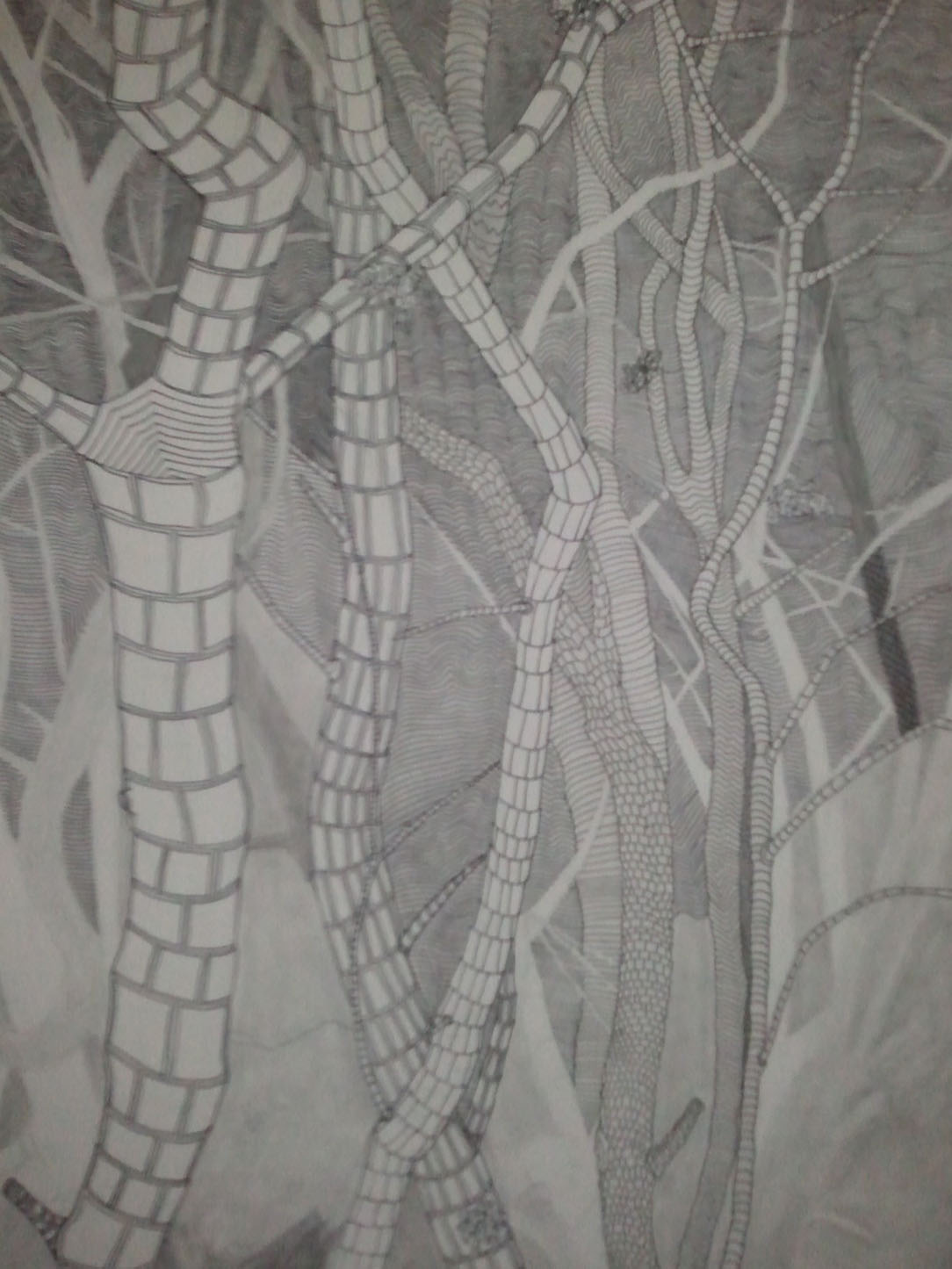
This may be a little risky since my drawing is still in progress, but I wanted to show you what I’m doing. I am giving you the ‘behind the scenes’ of my first time working through my own idea. This is the first attempt at connecting my shapes with landscape. Creating a piece of work that is engaging and intriguing.

The drawing is coming along slowly but surely. For the intricacy I get with the buildup of line – it takes so long. Usually when I’ve spent four hours working – I get only a few parts drawn in. That’s the way it’s been for me, my work is so intricate that the process is drawn out (forgive the pun!) and taxing. I love the results, but if I want to build up a portfolio I could end up spending a couple of months per drawing (on a 22″ x 30″ piece of paper) which would equal out to two years for 12 drawings.

1st picture of work in progress

Previous photo

2nd picture drawing in progress...

Current state

This new drawing has been quite an incredible experience. I’ve spent the last few months getting my initial ideas on paper and fine tuning issues that come up in the process. I have come across a few points where I have to be creative about my approach.

Working with pen and felt marker has been a unique challenge in its own right. The trouble I’ve been having with drawing with pen is that once you lay down your line you can’t undo it. When I was working on my first smaller abstract line drawings, it wasn’t a big deal because it ended up becoming a new evolutionary move. Now that I’m putting pattern on landscape, the lines have more importance. Like a cast in a play, each set of pattern plays it part. I have become quite timid at certain points in my drawing because I have to be more strategic about what I put where.  At this point I know the only way to correct a problem would be to paint over it with an acrylic white or cut it out with an exacto knife. This is the same problem I have with felt markers. Unlike ink washes, which you can dilute and build up, felt markers are much less workable. There are sections I ended up cutting out because the marker built up in one area too heavy. (The dark brown areas of the drawing above are from the masonite board underneath, I plan on adding a new section of paper underneath to create depth).

I have been looking into ways in which I could have more freedom with my drawings. Because of this, over the next couple of months I am going to spend time learning how to work with Illustrator. I think it could be the answer I’m looking for with my line drawings. The ability to make quick changes and work with layers would be a great advantage with my line work. It’s worth a shot!

Have a great week everyone! I will be writing on Tuesdays only from now on, so come back and see me then!

Beka

Perfecting my procrastination, I have decided to write about the lessons I’ve learned when writing an artist statement instead of posting my current statement online for all to see. My new goal time for completing my new artist statement will be after I’ve posted two new drawings online. Before I begin, I’d like to clearly state that I am not an authority on artist statements and all my experience comes from what I’ve gleaned from my art professors and my own experience. If you have any helpful advice to add, be my guest – I would love to have a dialogue about this subject.

Here it is…

Back in college I wrote several artist statements and was left confused by the process. It seemed like the artist statement was a piece of art in its own right, one that I didn’t quite understand how to create. Now that I’ve gotten a chance to work on my own, I realize that there is more to the artist statement than meets the eye.

Writing an artist statement forces you to break free from your creative cocoon and evaluate what you are doing. In this mode you step back, see how far you’ve come and where you’d like to go with your work. As an artist, your work evolves just as your creative capabilities grow. You need to update your artist statement in response to this change. Keeping a journal is handy for recording your inspired thoughts as soon as they pop up in your mind.

If you don’t understand why your work is the way it is, how can you expect to be able to tell others about it?

The initial problem when writing my first artist statement was that I didn’t have a clear idea of my work (it was all over the place – too many ideas at once). While it was good for me artistically, I found it difficult when trying to put my exploratory work into words. One of my teachers suggested that my classmates and I keep a journal. Having a journal definitely helped me to come up with more precise ideas about my own creative niche.

Purpose:

First off, it’s important to put  your ideas down on paper so you can figure yourself out, like a puzzle. Sometimes the creativity comes gushing out and you have to take a step back and analyze why it has come to be if you want to explain its existance to others. Here are some good probing questions:

Did a certain idea spark your interest when you first started this work? Did some kind of revelation occur? What do you want others to see when they look at your work?

Who is your audience? How do you want to interact with them when narrating?

What materials are you using? Why?

Do you get inspiration from any other artists work? What connection does it have to your work?

= = = = = = = = = = = = =

This is where I am right now – the figuring myself out part. I’m sure there are many of you who already know how to write a decent artist statement, hats off to you :). I am still hammering out the details. When I do write up my statement, I will go into more description on my blog.

Good night and Good luck!

Beka